
Part of the fun of writing about a character like Caterina Sforza is the people this famed woman encountered. Popes, cardinals, generals, philosophers, and artists all encountered Caterina at various points in her life.
From Book One:
When she was younger, Caterina was in Milan at the same time as Leonard Da Vinci, whom her uncle had hired as court artist. While there is no evidence Caterina met the great man, it’s highly likely. Da Vinci not only painted the Duke’s current mistress, but also designed a giant bronze horse sculpture that would stand in front of the ducal palace in Milan.

Image: Wikimedia Commons, Horse Drawings by da Vinci.
While his horse was never built (the materials went toward making cannons), da Vinci’s designs still exist.

Image: Wikimedia Commons, Portrait of Cecilia Gallerani, by Da Vinci.
Da Vinci also painted Duke Ludovico’s mistress, Cecilia Gallerani, in this famous painting called, ‘Lady with an Ermine’. It’s one of only four surviving paintings of women da Vinci did and is unusual because the subject is looking to the side, rather than out at the viewer. The ermine is not only a symbol of purity but is also one of the personal emblems used by the duke.
Another artist Caterina probably met is Sandro Botticelli. He was invited to Rome with other famous painters to paint the walls of the newly built Sistine Chapel for Pope Sixtus IV, for whom the chapel is named, and included both Caterina and her first husband, Girolamo Riario, in one of his pieces.

Image: Wikimedia Commons, The Healing of the Leper, Botticelli.
In the painting ‘The Healing of the Leper’, part of the Temptation of Christ cycle, Botticelli includes many of those in Sixtus’ inner circle.

Image: Wikimedia Commons, Close up image of Caterina Sforza in Botticelli’s painting The Healing of the Leper.
Caterina is shown on the right, pregnant and carrying a bundle of wood on her shoulder. By her feet is a child, possibly her son Ottaviano, with a viper, the symbol of the Sforza’s, at his feet.
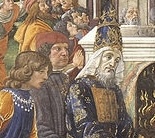
Image: Wikimedia Commons, Close up image of Girolamo Riario in The Healing of the Leper by Botticelli.
Caterina’s first husband, Girolamo Riario, appears on the left wearing a red cap, behind the priest. Correspondence and records from the time describe him as being sullen, and Botticelli’s depiction seems to reflect this!

In part two of Turning the World to Stone, Caterina has her portrait painted by Lorenzo di Credi. Her unadorned ‘Florentine’ appearance really did upset Milan.

The Birth of Venus by Sandro Botticelli, Wikimedia Commons.
When Caterina lived in Florence in a borrowed villa, Botticelli’s paingint of the Birth of Venus was on one of those walls.

During her time in Florence, Michelangelo’s famed statue of David was finished and displayed.
Copyright Kelly Evans
 Kelly Evans - Author